If you open the cheats page for a Nintendo, Sega or early PlayStation game here, there is now a section near the bottom called Emulator cheat codes. It covers twelve systems: NES, SNES, Game Boy, Game Boy Color, Game Boy Advance, Nintendo 64, Nintendo DS, Genesis / Mega Drive, Master System, Game Gear, PlayStation and PSP.
The codes come from libretro-database, the open cheat collection behind the RetroArch emulator. It holds tens of thousands of cheat files, published under CC BY-SA 4.0. We did not write these codes and we have not tested them. What we did do was decide which ones should appear on a page, and that decision needs explaining.
A code goes on a page only if exactly one game owns it
A cheat file is named after a game, a system and a version, for example Super Mario World (USA).cht. We attach it to a page only when the file's title matches the name of one game in our catalogue, on the same system, and no other game in the catalogue answers to that title on that system.
If two entries could claim the title, the file is skipped. We do not guess. A Game Genie code for the wrong game is worse than no code, because it looks exactly like a right one.
This has a visible side effect, and you will run into it. Our Zelda: A Link to the Past page currently shows one set, and it is for the Japan version. libretro has a USA file too. Its English title matched more than one entry in our catalogue, so it was skipped, while the Japanese title (Zelda no Densetsu: Kamigami no Triforce) matched exactly one. Donkey Kong Country shows only its Japanese set, Super Donkey Kong, for the same reason. The version is printed on the set so nobody tries it on the wrong copy, but it is a gap and we know it is there.
What we threw away
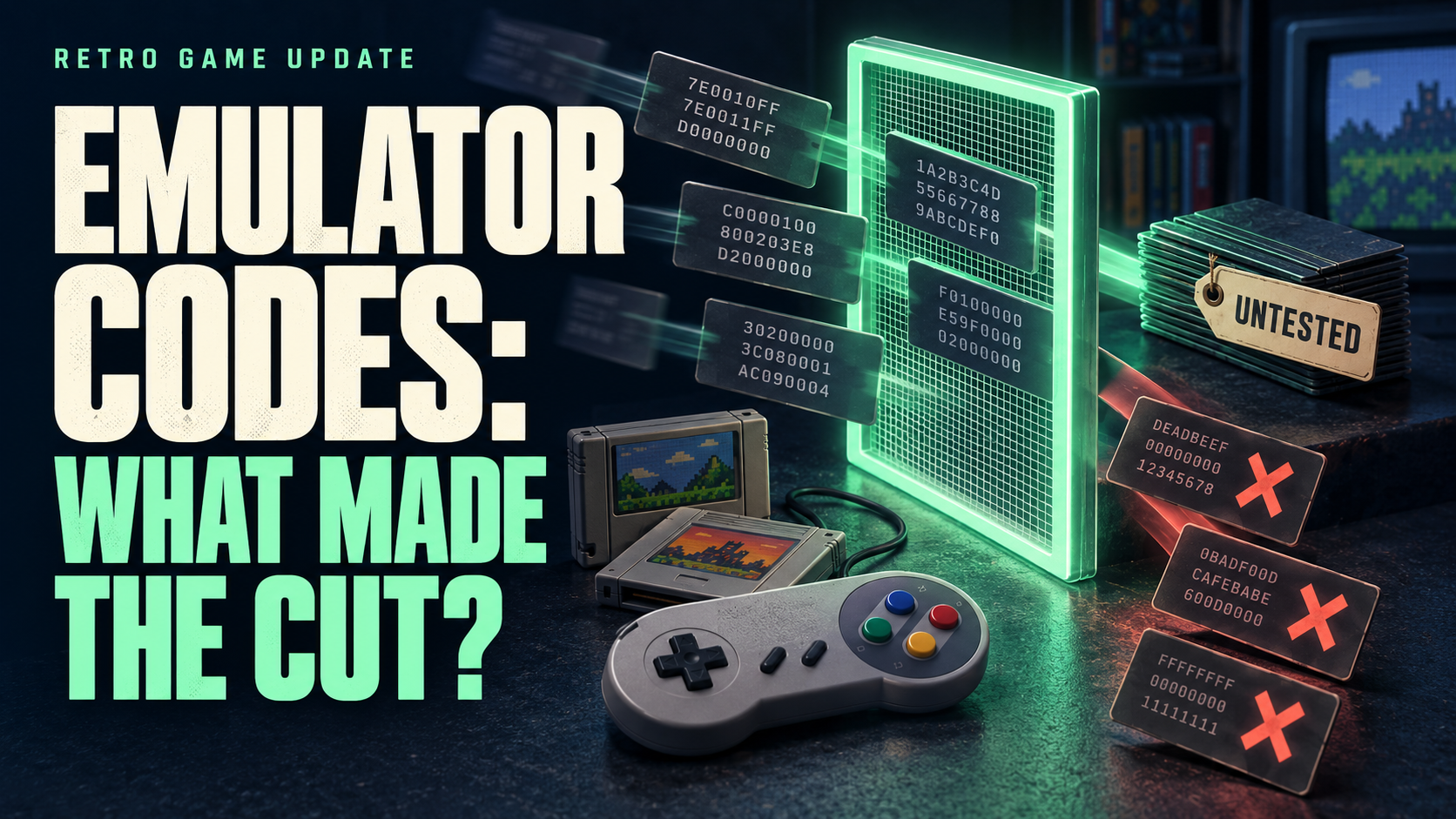
The first import went up as the files came. Reading the pages afterwards turned up problems no reader should have to sort through, so these rules now run before anything is saved:
- Placeholder codes. Some entries read
D001CD48+????, where you are meant to fill in the question marks yourself. That is a template, not a code, so any code containing a?is dropped. - Damaged entries. Real cheat-device codes carry at least an address and a value. A code with fewer than six letters or digits, such as a bare
65809, has lost part of itself and is dropped. So is any code with no description, or with characters no code device uses. - Sets in another language. Several files are German or French collections under an English filename. If 15% or more of a set's descriptions are in another language, the whole set goes. When an English set has a few stray German lines pasted in, those lines go and the set stays.
- Sets that do nothing on their own. A file whose only codes are a "master code" or "enable code" switches the cheat device on and changes nothing you can see. Any set with fewer than two codes that actually do something is dropped.
- Versions nobody owns. Betas, prototypes, demos, hacks, fan translations, pirate carts, and re-releases on other hardware such as a GameCube Edition or Virtual Console build. Each of those is a different ROM, so its codes belong to a different game.
- Very long sets. A set shows at most 150 codes. Past that point a page stops being readable, and the link under each set leads to the full file.
On 15 September we audited 75 retro cheat pages across all twelve systems: 145 sets and 6,198 codes. We found no placeholder codes, no damaged short codes and no foreign-language descriptions. Every set traced back to a file in the current source list.
What these codes do not change
The emulator codes live in their own table and their own section. They do not count towards a game's cheat total. They cannot earn the tested label, which means only one thing on this site: a person here entered that code, in that game, and watched it work. They also do not decide whether a page appears in search results. A page with nothing but third-party codes is still a thin page, and it is treated as one.
Each set names its device, system and version, links to the exact libretro file at the exact revision we read, and carries the licence it was shared under. If a set looks wrong, that link is where to check it, and tell us.
If the codes themselves look like noise, our guide How to Read a Retro Cheat Code explains which part is the address, which part is the value, and why the version matters.